
Last updated: November 19, 2026
Quick Answer: For most family trips, start with the route with 0 transfers; if that is not available, choose 1 transfer and aim for a wait under 10 minutes. In How to Pick a Family Transit Route That Minimizes Transfers and Waiting Time, a direct bus route often beats a faster-looking subway line with one awkward transfer and a 20-minute wait, especially when you are traveling with children or bags.
Key takeaways
- Fewer transfers usually matter more than shaving a few stops off the ride.
- A route with 10-minute service can beat a “shorter” route with a 30-minute gap.
- Platform changes, stairs, and long walks count as transfer burden, not just the number of lines.
- Carrying bags, a stroller, or tired kids makes first and last mile planning part of the route choice.
- For a 6 p.m. arrival, the route that looks best on paper may not be the best choice if headways widen.
How do I choose the family transit route first?

Choose the route that keeps the trip simple from door to door, not just station to station. In How to Pick a Family Transit Route That Minimizes Transfers and Waiting Time, the best starting point is usually the option with one line, one vehicle, and the fewest places where everyone has to stand still and wait.
Start with the full trip, then compare three things: number of transfers, time between vehicles, and how hard each transfer is. A 12-minute wait on a cold platform can feel longer than a 12-minute ride, especially with bags, snacks, and a child who needs the restroom.
Use the transit route, bus route, subway line, regional rail, transfer station, and timetable together, not as separate decisions. A route that looks quick on a map may have two platform changes and a 15-minute wait at the transfer station. That is often worse than a longer direct ride.
Therefore, use this rule when choosing among options:
- Prefer direct service first.
- If a transfer is unavoidable, pick the transfer with the shortest walk and the clearest platform change.
- If two routes are similar, choose the one with more frequent service during your travel window.
- If the trip includes a stroller, heavy bag, or young child, consider checking station accessibility guidance or asking your transit agency if stairs and crowding are a concern; the U.S. Department of Transportation’s ADA guidance is a useful starting point: https://www.transportation.gov/individuals/ada
Because the route that is easiest for adults with light bags is not always the best route for a group, a route with a neat 3-minute transfer can still fail if it requires crossing a busy station, changing levels, and waiting in a crowded concourse. The better choice is the one that keeps motion simple.
What should I compare on a timetable?
Compare service frequency, transfer times, and station layout on the timetable before you compare total ride time. The timetable shows the real risk: a route that runs every 8 to 10 minutes is much easier to trust than one that leaves every 30 minutes.
Look at three numbers on each option: the scheduled wait, the in-vehicle time, and the transfer gap. If one route saves 7 minutes on the ride but adds a 15-minute wait, it is usually the worse family choice. If the route has only one departure each hour, a 5-minute delay can wreck the whole plan.
For example, a useful shortcut is to sort options by the part that hurts most when a child is present:
| Route type | Best for | What to watch | What to skip |
|---|---|---|---|
| Direct bus route | Short trips and simple boarding | Traffic delay and crowding | Long rides with limited seats |
| Subway line with no transfer | Fast movement across a city | Stairs, platform gaps, and rush-hour crowding | Stations with long walks between lines |
| Regional rail with one clean change | Longer trips with fewer stops | Sparse departures and missed connections | Tight transfer windows |
| Route with one easy transfer station | Balanced trip times | Platform changes and extra waiting | Complex station layouts with elevators far apart |
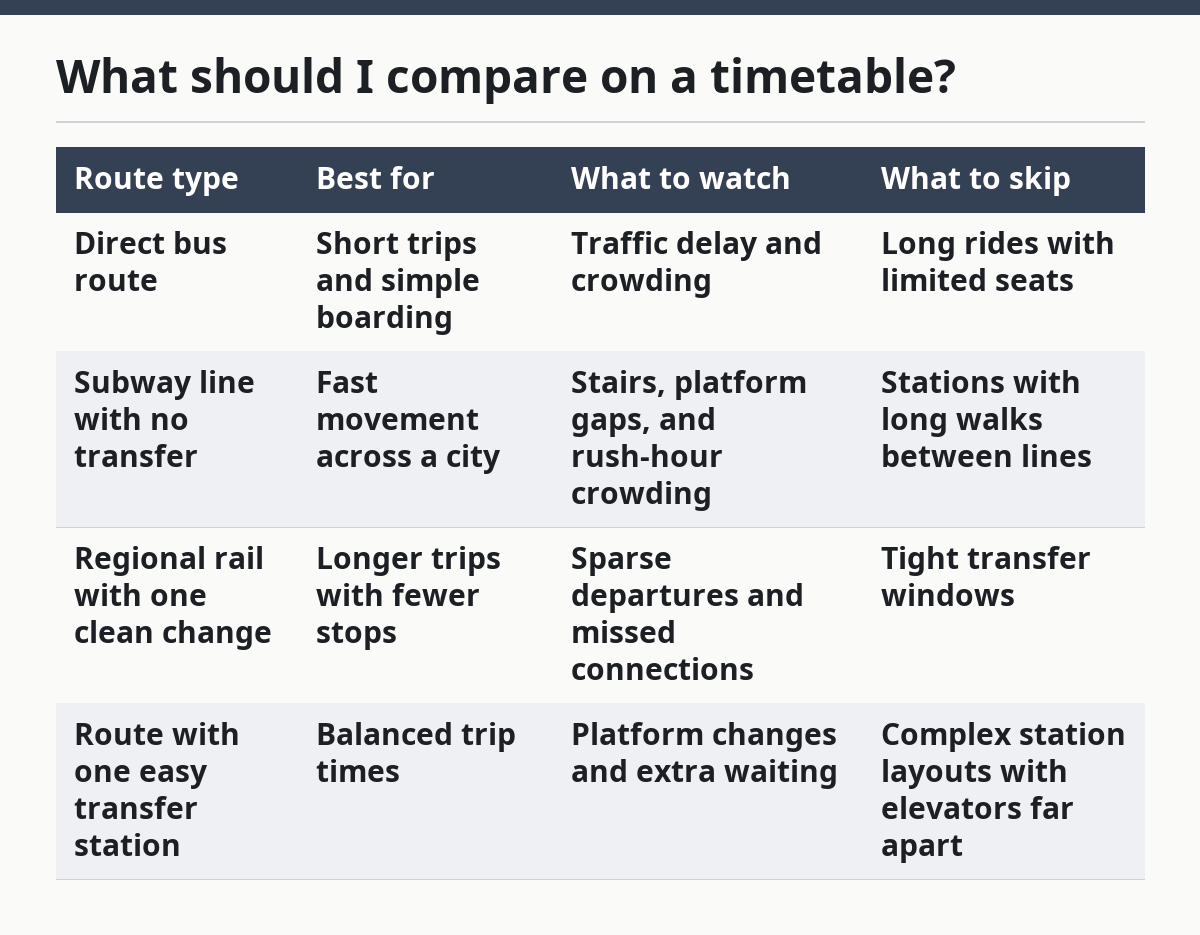
A table like this helps when the map makes every route look equal. The real difference is not only travel time; it is the amount of uncertainty. A family route should absorb a small delay without turning into a scramble.
Specifically, one practical source for route and schedule comparison is the transit agency’s timetable page for the line you plan to use. For general transit planning standards and service language, the Federal Transit Administration explains transit basics here: https://www.transit.dot.gov/
For trip-planning concepts and service planning language, the American Public Transportation Association is a useful reference: https://www.apta.com/
For accessibility and station-design context, the U.S. Access Board’s ADA standards are also useful: https://www.access-board.gov/ada/
Which transfer station is least painful?
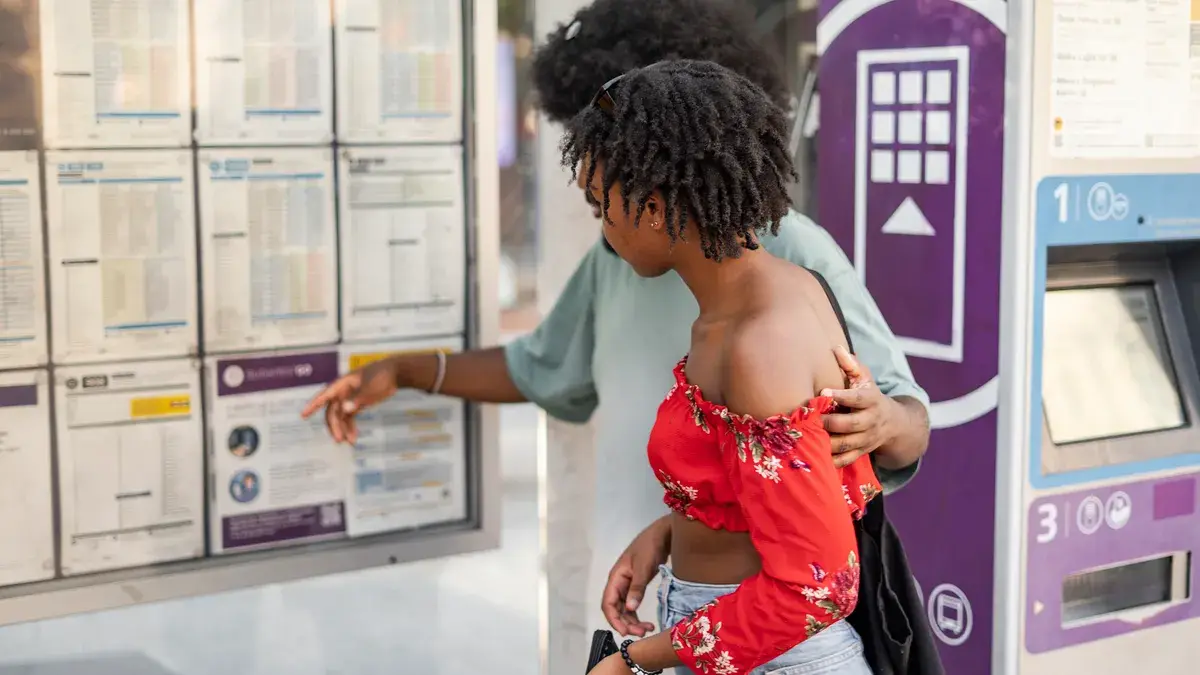
The least painful transfer station is the one with a short walk, one clear platform change, and no guesswork. A “2-minute transfer” on paper is not useful if it requires stairs, a level change, or a long platform walk with children and bags.
When you compare transfer stations, check the physical path, not only the timed connection. A same-level change is easier than a cross-platform change that still sends you through a crowded corridor. A 4-minute scheduled transfer with a simple cross-platform move can be better than a 7-minute transfer that requires two escalators and a hallway.
Therefore, the best transfer station for a family route usually has these traits:
- Clear signs from one platform to the next.
- No long backtracking.
- Enough space to stop for 30 seconds without blocking traffic.
- A connection that does not depend on perfect timing.
Bad transfer stations cost time in small pieces. One child asks for water, someone drops a glove, and the connection is gone. That is why a route with a slightly longer total ride but a cleaner transfer can be the stronger choice.
This is where many generic trip guides get it wrong. They treat every transfer as equal in practice, even though transfer difficulty can vary a lot. In real use, a transfer from a subway line to another subway line is not the same as a transfer from a bus route to a regional rail platform. The station shape matters as much as the line name.
How do I plan for bags, strollers, and tired kids?
Plan for bags, strollers, and tired kids by adding one layer of slack to the route, even if the timetable looks clean. A trip that works for one adult with a backpack can fail for a group carrying a stroller, a diaper bag, and a suitcase.
Think in terms of handling, not just riding. If you will need to lift, fold, drag, or carry anything heavy, avoid a route that depends on a tight 5-minute transfer. A direct bus route may be slower on paper but easier in practice because there is no platform switch and no rush through a station.
Since the first and last mile matter here too, a route that ends 15 minutes from the hotel can be worse than one that ends 8 minutes away if the last part needs a long walk on uneven sidewalks or several crossings. For a family trip, the last mile is part of the route, not a separate detail.
Seat availability also changes the route choice. A regional rail trip with better odds of a seat can be easier than a standing-only subway segment with one transfer. The same is true on a crowded evening bus route, where a few extra minutes in motion may still be easier than standing through a switch.
If the trip includes a stroller, heavy bag, or young child, use the station’s accessibility information and, if needed, consult your transit agency before you go. Skip the route that assumes everyone can move quickly at the same pace. That usually means anyone with small children, a stroller, heavy luggage, a mobility aid, or anyone who wants the simplest possible ride should avoid a connection that looks tight on paper.
When is a direct route worse than a route with one transfer?
A direct route is worse when it runs too rarely, crowds badly, or adds too much total time at the wrong hour. A one-transfer route can be the better choice if the first line is frequent and the transfer station is simple.
The key is the service pattern. A direct bus route that comes every 25 to 30 minutes can be a worse family option than a two-leg trip where each leg runs often and the transfer is painless. The risk is not only waiting; it is the fear of missing the one bus and losing the next chunk of time.
Choose the one-transfer route when all of these are true:
- The first leg has frequent service during your travel window.
- The transfer station is simple to cross.
- The second leg has enough frequency that a small delay does not ruin the trip.
- The total route does not depend on a single narrow connection.
Stay with the direct route when the transfer is awkward, the timetable is thin, or the station is hard to read. A direct ride with a little traffic or a few extra stops is often the safer family choice than a “faster” plan with a platform change and a nervous wait.
This is also where budget and convenience meet. A route can be cheap and still be a bad fit if it steals half the afternoon in waiting. That is why route planning should focus on transfer burden and waiting time together, not on fare alone.
How do I avoid the most common route mistakes?
Avoid the most common route mistakes by planning around the parts that waste the most time: long waits, hidden platform changes, and tight arrival windows. The mistake is rarely choosing the wrong line name; it is choosing a route that looks tidy but breaks once a child is slow to board.
Here are the main errors and what they cost:
- Choosing the fastest ride time only: it can lead to a transfer station that adds 10 or 15 minutes of walking and waiting.
- Ignoring service frequency: it can turn a small delay into a missed connection.
- Forgetting the last mile: it can leave the group tired before the trip is over.
- Assuming every transfer is simple: it can mean stairs, crowds, and confusion.
The fix is to score the route as a whole. Ask which option has the fewest moving parts, then check whether the timetable supports that choice at the exact hour you need. A route that is fine at 11 a.m. can be poor at 6 p.m. if headways widen.
The other mistake is picking a route with one clean connection but no backup if the first vehicle is late. If the next leg runs every 20 to 30 minutes, that route becomes fragile. For a family trip, fragility is the hidden cost that people notice only when they are standing on a platform with bags and a tired child.
What route should I pick if two options look close?
So, if two options look close, pick the route with the lower waiting risk, not the one with the prettier travel time. If two options are close, favor the route with the shorter transfer walk, more frequent service, and the easier boarding pattern.
When the choice is close, this order usually helps:
- Direct route with frequent service.
- One-transfer route with simple station change.
- Faster-looking route with a long transfer gap.
- Route with multiple platform changes, even if the ride time is shorter.
That order works because waiting time is the part most likely to expand without warning. A 3-minute transfer can become a 12-minute problem if the first vehicle is late by a few minutes. A route with a little more ride time but a 10-minute service pattern is often more forgiving.
Use this as the final check: if the route would still feel acceptable after one small delay, it is probably the right one. If one missed connection turns the whole trip into a mess, choose a different line or a different timetable slot.
This page fits the wider budget family trip routing and connection planning hub because the same logic applies across destinations: reduce transfers, reduce waiting, and keep the route easy to carry. The best family transit route is not the shortest line on the map. It is the one that keeps the group moving with the fewest stops, the fewest surprises, and the least time spent standing still.
Drafted with AI; not yet reviewed by a person.