
Last updated: November 19, 2026
Key Takeaways
- Match low demand with weather, open hours, and your family’s schedule.
- Compare total trip costs, including fees, meals, and transport.
- Build around 2 paid activities and fill the rest with low-cost blocks.
- Check opening hours, weather, and kid comfort before booking.
Cheap family travel in the off-season is mostly about picking a quieter week, not a worse trip. How to Plan a Cheap Family Vacation in the Off-Season works best when you match the calendar to your family’s needs. The cheapest family vacation is often the one that fits your school calendar, a calmer destination, and shorter attraction hours without turning the trip into a washout. The steps below show how to choose the right window, avoid bad trade-offs, and keep the trip kid-friendly. For timing basics, see the family travel calendar and how to save on family vacations.
What off-season family travel really means
Off-season family travel means you go when a place has fewer visitors, lower occupancy, and shorter lines, but it does not mean every place is cheap or pleasant at the same time. That matters because off-season can be a bargain for hotels and rentals, while deep off-season can mean fewer open restaurants, reduced shuttle service, and attractions that cut hours from 9 a.m. to 5 p.m. down to weekends only.
Picture this: you’re eyeing a beach town in late September or a mountain town in early spring, and you need to know if the savings are real or if you’re buying rain, closed doors, and cranky kids.
The useful term here is shoulder season. That is the stretch just before or after peak season, when demand is softer but the place still runs close to normal. The U.S. National Park Service and many destination tourism boards use this kind of seasonal timing to describe lower-demand periods, and that matters because off-season can be a bargain for hotels and rentals. Deep off-season can mean fewer open restaurants, reduced shuttle service, and attractions that cut hours from 9 a.m. to 5 p.m. down to weekends only. See the U.S. National Park Service and the U.S. Travel Association for destination planning context.
The best off-season choice is the window where price drops without breaking your plan.
A family-friendly off-season plan usually balances four things:
- Weather: mild enough for the activities you want
- Hours: attractions open long enough to fill a day
- School schedule: no attendance trouble, make-up work, or sports conflict
- Kid tolerance: less waiting, less car time, fewer sudden changes
A generic money-saving article often stops at “travel when it’s cheaper.” That misses the point. A $120-a-night room is not a deal if the pool is closed, the museum opens only 10 a.m. to 2 p.m., and your kids still want the same amount of entertainment. The real win is a trip that still feels like a trip. For compare-first planning, the hotel deal checklist helps you avoid false savings.
How do you pick the right off-season window?
You pick the right off-season window by matching low demand with usable weather and enough open hours for your family’s daily rhythm. The right window is usually the one that gives you the lowest workable price, not the absolute lowest price.
Picture this: you’re comparing two October weekends, one with a lower room rate and one with better weather, and you need the one that will actually work with two tired kids and a 7 p.m. bedtime.
Start with the school calendar. If you need Friday through Sunday, your options are tighter than if you can leave on a Tuesday or return on a Thursday. Many families save more by moving the trip by just 2 days than by changing destinations.
Then check the weather trade-off. Off-season often means cooler temperatures, more rain, shorter daylight, or wind that changes what you can do outside. If your plan depends on a beach day, boat ride, or long walking tour, a rainy week can erase the savings fast. If your plan is mostly museums, indoor pools, or city parks, a chillier forecast may not matter much.
Next, look at destination hours. A lot of attractions trim hours in quieter months. Some close midweek. Some stop timed-entry slots earlier. If a child is excited about one specific zoo, aquarium, or theme park area, confirm the hours before you buy anything nonrefundable. For date-sensitive planning, the best time to book a family vacation guide can help.
Use this quick filter:
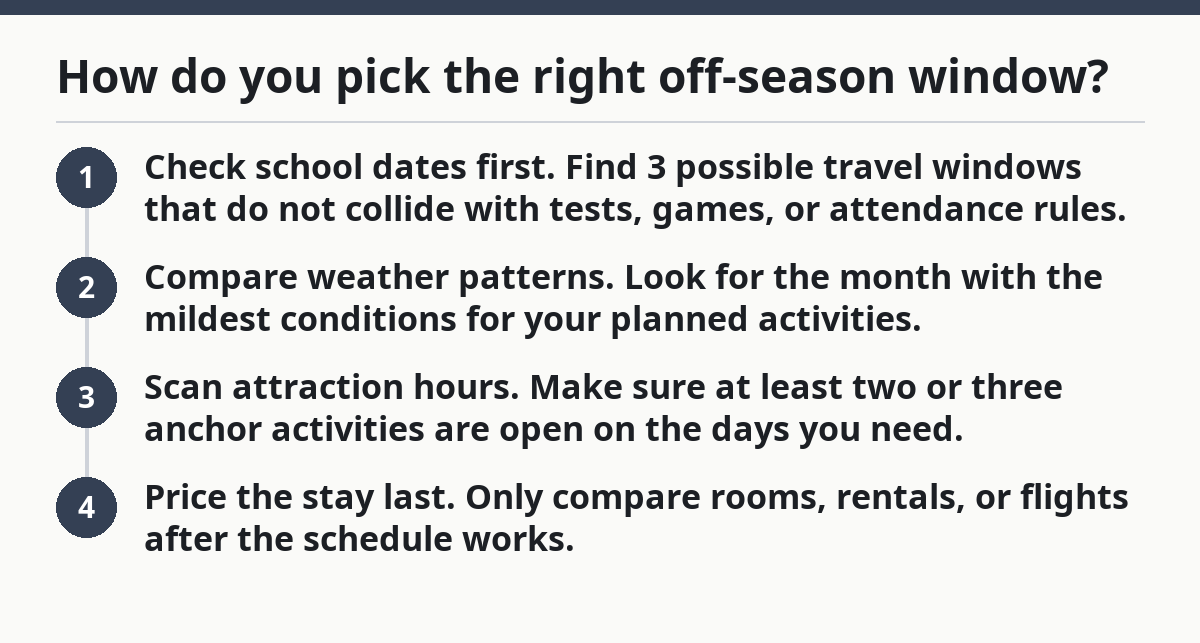
- Check school dates first. Find 3 possible travel windows that do not collide with tests, games, or attendance rules.
- Compare weather patterns. Look for the month with the mildest conditions for your planned activities.
- Scan attraction hours. Make sure at least two or three anchor activities are open on the days you need.
- Price the stay last. Only compare rooms, rentals, or flights after the schedule works.
A family can save money by traveling in a quieter week, but the wrong week can cost more in skipped activities and takeout. That is the catch. If your timing is off, the trip gets more expensive even when the room rate is lower.
Which costs should you compare before you book?
You should compare the full trip cost, not just the nightly rate, because off-season savings can disappear in parking, meal, and activity costs.
Picture this: you’re staring at a cheap room rate and a family of four, then discovering the hotel charges for parking, the nearest lunch spot closes at 3 p.m., and the “included” pool is under repair.
The biggest mistake is comparing one line item and calling it a deal. A lower room rate can be offset by:
- Higher transport costs if the cheaper destination needs a car all week
- Shorter hours that force extra meals out of convenience
- Add-on fees like parking, resort fees, or bag checks
- Weather backup plans like indoor attractions you did not budget for
Make a plain list before you pay:
- Lodging for the nights you need
- Transport to and from the destination
- Local transport, parking, and tolls
- Meals, especially if the destination has thin off-season dining
- Tickets for the 1 or 2 big activities that matter most
- One indoor backup plan for each full day
A simple worksheet beats guesswork. If a rental is cheaper by $40 a night but adds a $25 parking fee and a longer drive to every meal, the savings may be much smaller than they look. If an off-season hotel offers free breakfast and a heated pool, that can be worth more than a slightly lower base rate elsewhere.
A smart off-season budget checks the whole day, not just the room. That means you should ask: will the kids be fed, busy, warm, and able to sleep on time?
One more thing: do not assume off-season means empty. Some periods are cheap because they are quiet; others are cheap because they are miserable for your plan. A coastal town in a windy month and a ski town after snowmelt are not the same kind of bargain. If your child needs a lot of outdoor time, a weather-heavy destination can be a poor fit even when the rate looks great.
How do you build a cheap family itinerary that still works for kids?
You build a cheap family itinerary by anchoring the trip around 2 paid activities and filling the rest with low-cost time blocks. A low-cost itinerary is easier to keep on budget because it limits ticket, parking, and snack spending.
Picture this: you’re in a destination with short hours and a modest budget, and you need a day that keeps everyone happy without buying a ticket for every hour.
A good off-season family day usually has a morning anchor, a midday reset, and one flexible evening option. That rhythm matters because kids get tired faster when a place is quieter and the day spreads out. If attractions close at 4 p.m., you want to get your key outing done early and leave space for downtime later.
Use this structure:
- Morning: one main activity, ideally the most reliable one
- Lunch: a simple place with short waits or food you brought
- Afternoon: indoor backup, nap, or free play
- Evening: one low-cost event like a walk, pool time, or local market if it is open
Here are the kinds of activities that work well in off-season:
- Museums with predictable hours
- Indoor pools or rec centers
- Parks and playgrounds when the weather is mild
- Self-guided city walks
- Visitor centers with maps and free exhibits
Pick one “must-do” for each full day, not five. If you overload the plan, you will spend more on tickets, parking, and snacks, and you will still end up cutting something. That is a common family-travel trap. The cheaper trip is usually the one with fewer moving parts.
If you want one paid splurge, put it on the day with the best weather forecast. A boat tour, zoo visit, or timed museum slot is easier to justify when the rest of the day can stay light and cheap.
What mistakes make off-season trips expensive?
The most expensive mistake is choosing a cheap date without checking what is open, what is wet, and what your kids can handle. For families, that usually means the lowest price is not the best value.
Picture this: you’re saving on the room, but your main attraction is closed on Tuesdays, the second option cuts hours at 3 p.m., and everyone ends up in a mall food court paying full price for lunch.
There are a few repeat offenders:
- Booking before checking hours. This can leave you with a location that looks good online but has thin weekday service.
- Ignoring weather by month. A destination may be cheap for a reason, and that reason may be sleet, heat, or wind.
- Over-planning each day. More tickets means more stress and less margin for delays.
- Skipping backup options. One rainy afternoon can become an expensive scramble.
- Forgetting school constraints. A “cheap” trip that causes missed work, make-up assignments, or a sports conflict is not really cheap.
The fix is simple but strict: build around what will actually be open, not what the marketing photo shows. If an attraction’s quiet-season hours are 10 a.m. to 4 p.m., do not plan a late start and a long dinner. If the area gets early sunset in December, your outdoor time ends sooner than you think.
A good rule is to check 3 things for every destination:
- The month’s usual weather pattern
- The current attraction hours for your key stops
- Your family’s real tolerance for cold, heat, rain, and short days
That rule saves more money than chasing the lowest headline price. It also cuts the chance of last-minute changes, which are where families usually overspend.
A simple step-by-step plan you can use this week
You can plan the trip in one sitting if you start with dates, then weather, then prices, then activities. That order keeps the off-season budget from drifting later.
Picture this: you’re at the kitchen table with a laptop open and a school calendar beside you, and you want a plan that fits a 3-day weekend without blowing the budget.
- Choose 3 possible travel windows. Use weekends, teacher-work days, or a school break edge if your schedule allows it. A 2-day shift can change the price a lot.
- Check typical weather for each window. Look for the month that best matches your planned activities, not the month that sounds cheapest.
- Check attraction hours and closed days. Confirm at least 2 anchor activities will be open when you arrive.
- Price lodging and transport together. A cheaper room with a longer drive or higher parking fees may not win.
- Build a day plan with 1 paid activity per day. Leave room for free time, meals, and weather changes.
- Add one indoor backup. A museum, library, pool, or visitor center can save the day without much extra cost.
- Only then commit. If the dates still work after the full check, the trip is far more likely to stay cheap.
This order matters because it prevents the usual mistake: falling in love with a price before you know if the trip functions. If the timing or conditions look uncertain, consider a travel advisor or another qualified professional, and verify details with current schedules before you book. A family vacation is not a single purchase. It is a chain of small choices, and one bad link can force a pricey fix later.
The best part? Once you have one good off-season template, the next trip gets easier. You already know which weeks, weather patterns, and hours work for your family. For more planning help, the family itinerary builder and cheap family vacation ideas pages are useful next steps.
Where off-season travel is a bad deal
Off-season travel is a bad deal when the savings come with closed attractions, rough weather, or a schedule your kids cannot tolerate.
Picture this: you’re looking for a bargain, but the pool is closed for maintenance, the only family restaurant nearby is open just 11 a.m. to 2 p.m., and the forecast says three straight days of rain.
That does not mean off-season is bad. It means off-season is selective. If your child needs beach weather, long daylight, and easy meal options, a deep off-season coastal trip can be frustrating even if it is cheap. If your family gets tired fast and likes museums, soft crowds, and shorter lines, the same window can be a strong fit.
Skip off-season travel when:
- Your main activity depends on perfect weather
- The destination has very limited hours in the quiet months
- You need the trip to fit a rigid school or sports calendar
- Your kids do poorly with abrupt plan changes
- The “deal” only works if you ignore fees or transportation
A cheap trip should still feel like a good trip. If the quiet season strips away the things your family came to do, the savings are false. Pick another window or another destination.
What counts as off-season for family travel?
Off-season is the quieter part of the year when a destination has fewer visitors, lower occupancy, and more limited hours than its peak season. For family travel, it usually sits outside school holidays and outside the busiest weather window for that place.
A town may have one off-season in winter and a different one in late spring, depending on what people normally go there to do.
The useful test is simple: if crowds are smaller, rates are softer, and some hours shrink, you are probably in off-season or shoulder season. The exact months vary by destination, so the calendar alone does not tell the whole story.
Is shoulder season better than peak season for families?
Shoulder season is often better than peak season for families because it can offer lower prices, lighter crowds, and more usable hours than the deepest off-season.
That said, shoulder season is not automatically better. If the weather is unstable or your child needs full-day outdoor activities, peak season may still be the easier fit despite the higher cost.
What tradeoffs come with off-season travel?
The biggest tradeoffs are weather, shorter attraction hours, and fewer open options for meals and activities.
You may save money on lodging, but spend more time adjusting plans around rain, wind, early sunset, or weekday closures. Off-season works best when your family can handle a more flexible day and does not need every option open from breakfast to bedtime.
Drafted with AI; not yet reviewed by a person.